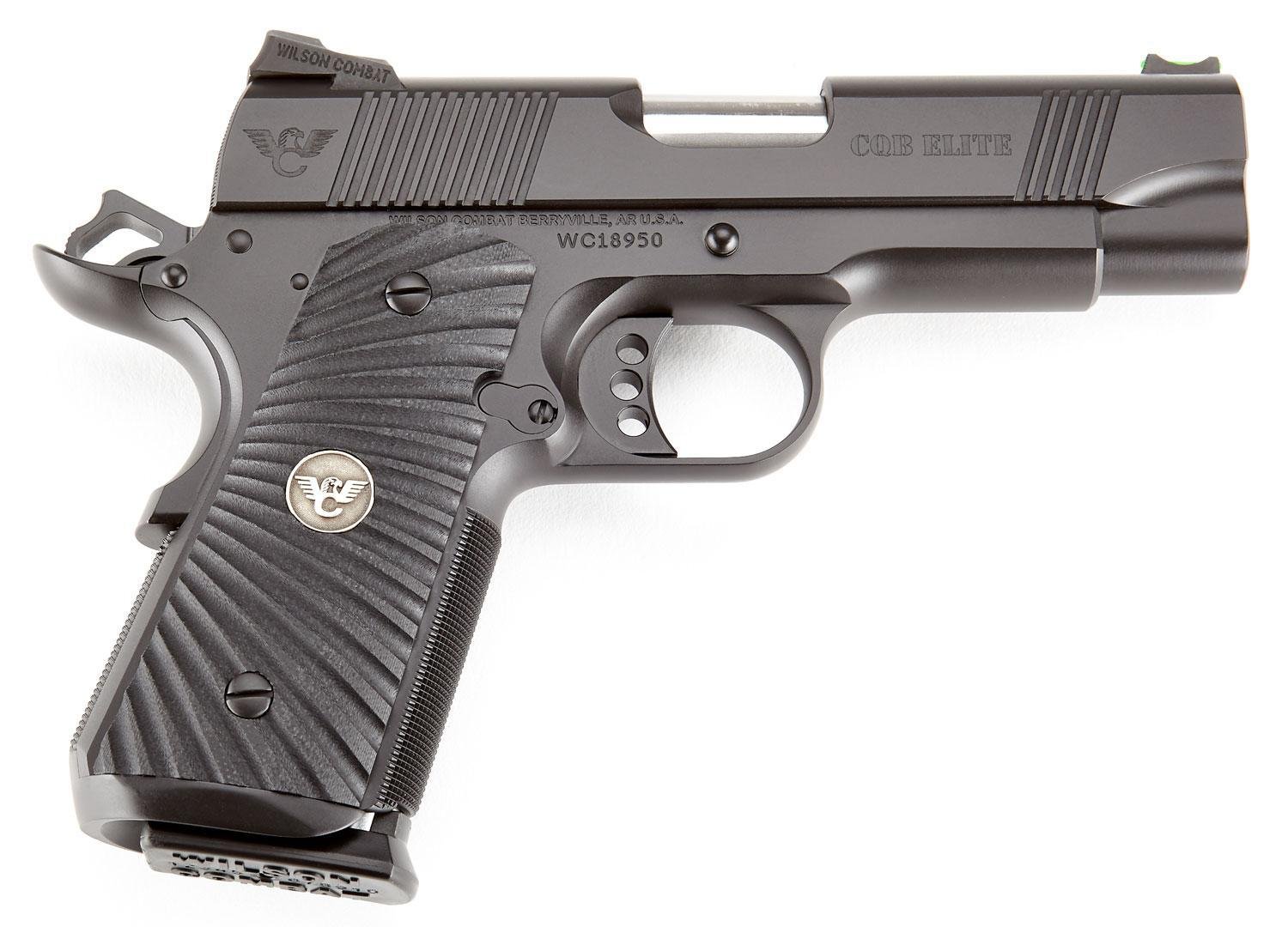
$3,700.00
Explore Wilson Combat 1911 pistols in 2026. Compare popular models, specifications, premium features, craftsmanship and reviews.
The Close Quarters Battle Elite Compact blows the competition away with a standard package of custom features designed to meet the needs of tactical shooting professionals. It features a carbon steel frame and slide, beavertail grip/thumb safety, G10 diagonal flat-bottom grips, and a rear battlesight with fiber optic front. The slide features top slide serrations with serrated rear and front cocking serrations. It also utilizes a stainless match-grade barrel.
The Wilson Combat 1911 is one of the most recognisable names in the world of premium American 1911-style pistols. Known for its association with custom gunsmithing, refined craftsmanship, and the long-established 1911 platform, Wilson Combat has developed a reputation among firearm historians, collectors, competitive shooting enthusiasts, and technical reviewers.
The company has produced numerous 1911 variations, ranging from traditional full-size configurations to compact designs and highly detailed custom-grade models. Each represents a different interpretation of the classic American semi-automatic pistol.
Understanding the Wilson Combat 1911 requires looking beyond its appearance. Its history, manufacturing philosophy, mechanical design, model variations, materials, and technical specifications all contribute to its identity.
This comprehensive guide explores the background of Wilson Combat, the development of its 1911 pistols, notable models, distinguishing characteristics, and important considerations for responsible ownership.
The Wilson Combat 1911 is a family of semi-automatic pistols developed around the historic M1911 design originally associated with John Moses Browning.
The original M1911 entered United States military service in 1911 and became one of the most influential handgun designs of the twentieth century. Its distinctive profile, single-action operating system, and longstanding manufacturing history helped establish it as a major platform for commercial firearms development.
Wilson Combat became known for refining and customising this platform through specialised gunsmithing and manufacturing.
Unlike a single fixed model, the Wilson Combat 1911 name covers several configurations with different dimensions, calibres, finishes, and design details.
Some models closely follow the traditional appearance of the original 1911, while others incorporate contemporary styling and modern manufacturing techniques.
The result is a diverse family of pistols that reflects both the historical significance of the 1911 and the evolution of modern firearm production.
Wilson Combat traces its origins to the work of Bill Wilson, who established a gunsmithing business in Berryville, Arkansas, in 1977.
During its early development, the company focused on custom firearm work and the refinement of existing pistol designs. The 1911 became particularly important to its identity.
As interest in specialised 1911 pistols grew, Wilson Combat expanded from custom gunsmithing into the manufacture of components and complete firearms.
Over time, the company developed a broader product portfolio while maintaining a strong association with premium 1911 pistols.
Its development illustrates a larger trend in the American firearms industry: the transition from individual gunsmith modifications to dedicated manufacturing businesses producing specialised variations of established designs.
Today, Wilson Combat is recognised for its connection to the 1911 platform as well as other firearm designs.
The M1911 has remained influential for more than a century.
Its long production history has encouraged numerous manufacturers to develop their own interpretations, from historically styled reproductions to highly customised contemporary versions.
The platform’s continuing popularity is partly connected to its recognisable design and the extensive body of technical knowledge accumulated around it.
For historians, the 1911 represents an important chapter in American military and industrial history.
For collectors, different manufacturing periods, model variations, finishes, and markings provide opportunities for detailed study.
For technical reviewers, the platform offers a useful example of how a historic mechanical design can evolve while retaining many of its original characteristics.
Wilson Combat’s contribution is best understood within this broader tradition of 1911 manufacturing and refinement.
Wilson Combat has introduced numerous 1911 models over the years. Their availability and exact specifications vary by production period, configuration, and market.
The Wilson Combat CQB is one of the company’s best-known model names.
It represents a modern interpretation of the traditional 1911 platform, incorporating the company’s distinctive styling and manufacturing approach.
The CQB has appeared in different configurations and chamberings across its production history.
Its design remains recognisably connected to the original 1911, with the familiar slide profile, grip arrangement, and general mechanical architecture.
When researching a particular CQB, it is important to identify the production year and configuration rather than assuming every example has identical specifications.
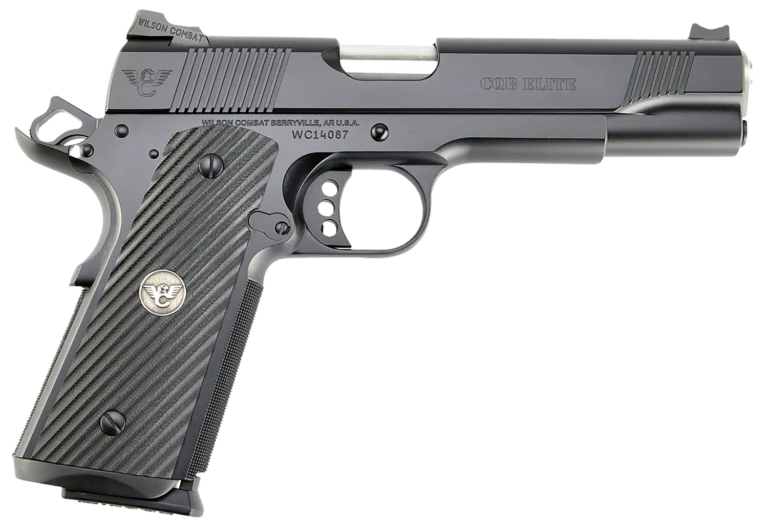
The CQB Elite is another established Wilson Combat model.
Its name is associated with a variation of the CQB concept featuring different design and configuration options.
Historical model records identify the CQB Elite in multiple chamberings, including .45 ACP and 9mm, along with other variations.
As with other custom-oriented firearms, the details of individual examples can differ.
Researchers should distinguish the CQB Elite from the standard CQB when comparing historical specifications.
The Wilson Combat Classic reflects the traditional side of the manufacturer’s product range.
Its styling draws heavily from the established appearance of the 1911 platform, while incorporating Wilson Combat’s own manufacturing and finishing practices.
The Classic designation has appeared across different configurations and production periods.
It is particularly relevant to discussions of how manufacturers preserve historical design characteristics while applying contemporary production methods.
The Classic Supergrade belongs to the manufacturer’s highly detailed custom-grade 1911 tradition.
The Supergrade designation has long been associated with an emphasis on workmanship, finishing, and attention to individual components.
For collectors and researchers, the distinction between a standard Classic and a Classic Supergrade is important.
These names identify different positions within the manufacturer’s historical product portfolio, rather than merely alternative cosmetic labels.
The Professional is another recognised model within the Wilson Combat 1911 family.
It represents a different size and configuration category from traditional full-size models.
The Professional name has appeared in historical manufacturer listings and state handgun records.
Researchers comparing models should pay attention to overall dimensions, barrel length, frame configuration, and the exact production version.
The Hunter represents a specialised branch of the Wilson Combat pistol range.
Historical handgun records list Hunter configurations in chamberings including 10mm Auto.
Its inclusion in the company’s product history demonstrates how the 1911 platform has been adapted into different specialised configurations.
Because the Hunter differs from more traditional 1911 variations, its specifications should be examined separately.
There is no single specification sheet that accurately describes every Wilson Combat 1911.
Different models and production configurations can vary substantially.
The following table provides a general overview of characteristics commonly associated with the 1911 platform.
| Specification | General description |
|---|---|
| Manufacturer | Wilson Combat |
| Country of origin | United States |
| Platform | 1911-pattern semi-automatic pistol |
| Operating action | Single-action |
| Frame materials | Vary by model |
| Slide materials | Vary by configuration |
| Chamberings | Include .45 ACP, 9mm and other model-dependent options |
| Barrel length | Depends on model |
| Magazine configuration | Depends on model and chambering |
| Finish | Multiple historical and contemporary variations |
| Sights | Configuration-dependent |
These details should not be treated as specifications for an individual firearm.
Manufacturer documentation, model markings, and production records are more appropriate sources when exact dimensions or components are required.
Several characteristics help distinguish the Wilson Combat 1911 family within the broader market for 1911-pattern pistols.
Many Wilson Combat models retain the recognisable architecture of the original 1911.
This includes the familiar frame and slide arrangement, single-action operating system, and general exterior profile.
Although individual components and finishes have evolved, the historical connection remains clear.
Wilson Combat has built much of its reputation around specialised gunsmithing and detailed component fitting.
Manufacturing quality is an important subject in technical discussions of premium firearms.
However, claims about the fit, performance, or reliability of an individual pistol should be based on actual inspection and documented testing rather than brand reputation alone.
Finishing is another significant aspect of the Wilson Combat product identity.
Different models may feature distinct surface treatments, textures, colours, and exterior details.
These variations can also help researchers identify production generations and specific configurations.
Grip design influences the external appearance and handling characteristics of a pistol.
Wilson Combat models have appeared with different grip materials, textures, and patterns.
The precise grip configuration depends on the model and production version.
Wilson Combat 1911 pistols have been offered with different sight arrangements.
The appearance and specifications of these components may vary by model, production date, and factory configuration.
Technical descriptions should identify the exact sight type rather than assuming all examples share the same design.
The 1911 platform has historically appeared in several chamberings.
Wilson Combat’s model history includes examples associated with .45 ACP, 9mm, 10mm Auto, and .38 Super.
The .45 ACP cartridge has a particularly strong historical association with the original M1911 platform.
Many traditional 1911 designs retain this chambering, making it an important part of the platform’s history.
The 9mm chambering is found in numerous contemporary 1911-pattern pistols.
Wilson Combat has produced multiple models associated with this cartridge.
Its presence in the company’s portfolio reflects the broader development of 1911 variants beyond the original military chambering.
Certain Wilson Combat models have appeared in 10mm Auto.
This chambering is associated with specific configurations and should not be assumed to be available across the entire product range.
The .38 Super cartridge also has a long history within the 1911 platform.
Historical records identify selected Wilson Combat models chambered for this cartridge.
When researching any specific model, always distinguish between chamberings documented for that configuration and those associated with other models in the same family.
A common research question concerns the differences between a Wilson Combat 1911 and a conventional production 1911.
The most important distinction is that the original 1911 describes a historical design platform, while Wilson Combat is a manufacturer producing its own interpretations of that design.
A traditional 1911 may emphasise historical styling, standardised production features, or faithful reproduction of earlier specifications.
Wilson Combat models frequently emphasise particular manufacturing details, custom-grade features, and configuration choices.
Neither description alone establishes the performance or quality of an individual example.
A meaningful comparison should examine specific models, their production dates, documented specifications, and independently verified evaluations.
It is also important to recognise that the 1911 market includes many manufacturers offering different levels of customisation and production complexity.
Wilson Combat’s history extends beyond conventional single-stack 1911 configurations.
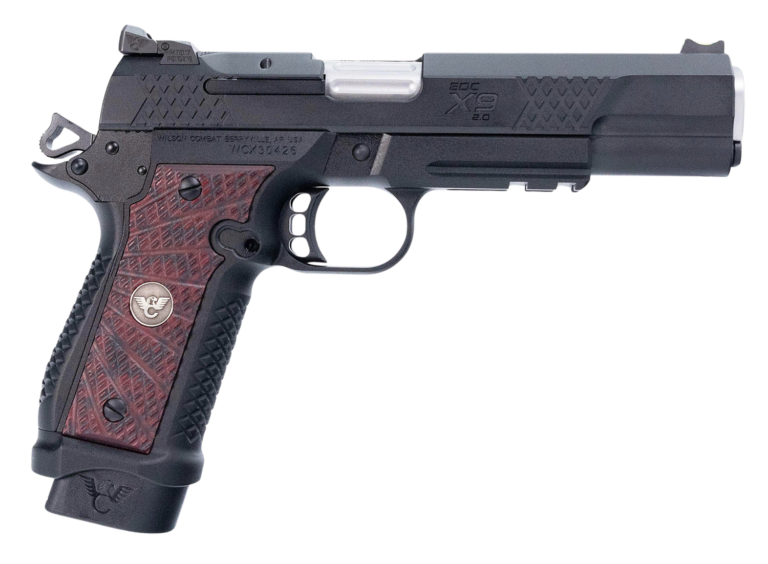
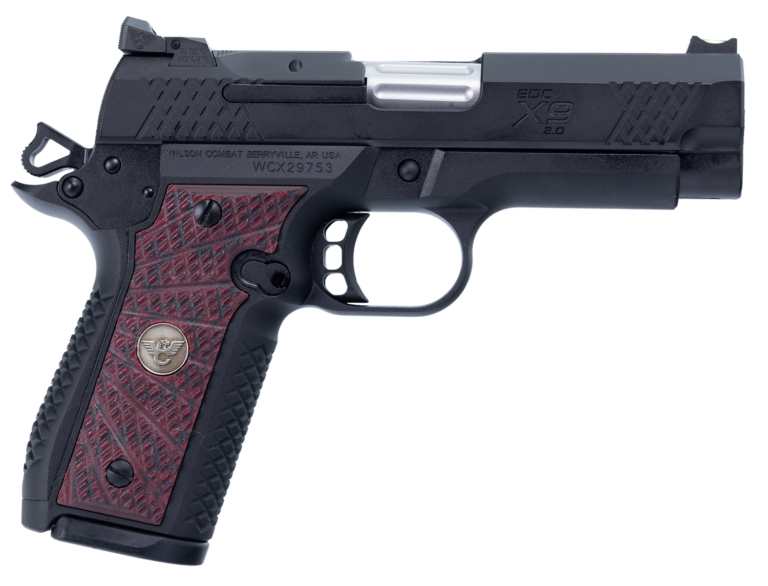
The company introduced the EDC X9 family as a modern pistol design drawing on aspects of 1911 styling while departing from the traditional platform in significant ways.
The EDC X9 is not simply a conventional 1911 with a different magazine.
It represents a separate design approach, and its technical characteristics should be discussed on their own terms.
The later EDC X9 2.0 further illustrates the manufacturer’s continued development of pistol designs beyond its classic 1911 models.
For accurate SEO content, pages about the Wilson Combat 1911 should distinguish traditional 1911 models from related but mechanically different product families.
This distinction helps readers understand the manufacturer’s broader history without confusing separate platforms.
Craftsmanship is one of the most frequently discussed subjects in reviews of premium 1911 pistols.
The term can encompass several different manufacturing characteristics, including surface finishing, component fit, machining, material selection, and overall consistency.
Wilson Combat’s identity has been closely associated with custom gunsmithing since its early history.
As the company expanded, that background became part of its manufacturing reputation.
Nevertheless, a useful technical review should separate manufacturer claims from independently observed results.
Statements about mechanical precision, durability, or reliability should be supported by documented measurements, inspections, or testing.
Visual quality and manufacturing complexity are also distinct from practical performance.
A well-written review should explain which characteristics were directly observed and which are based on published specifications.
Materials used in 1911-pattern pistols vary across manufacturers and models.
Steel has historically played a major role in the platform’s construction, while some contemporary configurations use alternative frame materials.
Different surface treatments and finishes can influence the appearance and maintenance requirements of individual models.
Wilson Combat’s product history includes several construction approaches.
For this reason, broad claims such as every Wilson Combat 1911 having the same frame material or finish would be inaccurate.
Researchers should refer to the exact model designation and applicable manufacturer documentation.
A comprehensive review should assess more than appearance or brand recognition.
Useful technical reviews clearly identify the exact model, chambering, production configuration, and conditions under which observations were made.
They should also distinguish subjective impressions from measurable characteristics.
For example, a reviewer’s opinion about appearance is inherently subjective, while dimensions and weight can be checked against documented specifications.
Reliability assessments require particular care. A single positive or negative experience does not establish the performance of an entire product line.
Similarly, manufacturer reputation should not substitute for evidence about an individual example.
When reading Wilson Combat 1911 reviews, consider the publication date, the reviewer’s experience, the model tested, and whether the conclusions are supported by transparent methodology.
Reliability is a recurring subject in discussions of 1911-pattern firearms.
However, it cannot be accurately summarised through a universal statement covering every Wilson Combat model and production year.
Individual condition, maintenance history, component integrity, and manufacturing differences can all be relevant.
A technical discussion should rely on verified evidence and avoid claims of guaranteed performance.
For owners experiencing mechanical concerns, the appropriate response is to stop using the firearm and seek guidance from the manufacturer or a qualified gunsmith.
Attempting undocumented modifications or repairs can introduce safety risks.
One of the challenges in researching Wilson Combat pistols is the number of historical variations.
A model name may remain in use while available configurations change.
Other model names may be discontinued, revised, or replaced.
Collectors and researchers should therefore pay attention to production dates and documentation.
Historical state handgun rosters can provide useful evidence that particular model names and chamberings existed during a given period.
However, those records should not be interpreted as proof of current production or availability.
Likewise, a photograph of a pistol does not necessarily establish its original factory configuration.
The most reliable descriptions combine model identification with authoritative records.
Proper care and safe storage are important considerations for any firearm owner.
The manufacturer’s documentation should be the primary reference for approved maintenance procedures and service intervals.
Owners should also follow applicable laws concerning possession, transportation, storage, and use.
When a firearm requires inspection or repair, a qualified professional should evaluate it.
Firearms should be secured against unauthorised access, particularly in environments where children or other vulnerable individuals may be present.
Appropriate storage practices and adherence to established safety rules are essential aspects of responsible ownership.
Wilson Combat pistols are relevant to collectors interested in the development of American custom firearms manufacturing.
The company’s history spans the transition from traditional gunsmithing services to complete firearm production.
Its model range provides examples of how the 1911 design has been adapted over multiple decades.
For collectors, distinguishing original configurations from later modifications is an important part of documenting an individual firearm.
Historical records, factory documentation, original markings, and reliable provenance can contribute to a more accurate understanding of a particular example.
Collector interest should not be confused with assumptions about investment value or future appreciation.
A Wilson Combat 1911 is a semi-automatic pistol produced by Wilson Combat using the historic 1911 design platform. The manufacturer has developed numerous models with different configurations, dimensions, and chamberings.
Wilson Combat was founded by Bill Wilson. The company’s history began with gunsmithing work in Berryville, Arkansas, in 1977.
Wilson Combat is associated with Berryville, Arkansas, United States.
Recognised historical model names include the CQB, CQB Elite, Classic, Classic Supergrade, Professional, and Hunter.
These models differ in their specifications and intended design characteristics.
No. Wilson Combat has produced multiple 1911 configurations, with differences in dimensions, chamberings, materials, finishes, and other design features.
No. The EDC X9 incorporates design influences associated with the 1911 but differs from a conventional 1911 in important mechanical and structural respects.
Historical models have appeared in chamberings including .45 ACP, 9mm, 10mm Auto, and .38 Super. Specific chamberings depend on the model and production configuration.
Wilson Combat’s longstanding connection to custom gunsmithing, its range of model variations, and its emphasis on manufacturing detail distinguish its place within the 1911 market.
Model markings, manufacturer documentation, original records, and the firearm’s physical characteristics can help establish its identity. A qualified professional may be needed when identification is uncertain.
Yes. They represent an important part of the modern evolution of the 1911 platform and the development of specialised American firearms manufacturing.
The Wilson Combat 1911 represents a distinctive chapter in the history of American firearms manufacturing.
From the company’s early gunsmithing work to its extensive family of 1911 models, Wilson Combat has maintained a strong connection to one of the most influential handgun designs of the twentieth century.
Models such as the CQB, CQB Elite, Classic, Classic Supergrade, Professional, and Hunter illustrate the variety within the manufacturer’s historical portfolio.
For readers researching the Wilson Combat 1911, the most useful approach is to examine specific models, verify technical specifications, understand the historical context, and distinguish documented facts from subjective reviews.
Whether the subject is firearm history, manufacturing techniques, model identification, or responsible ownership, accurate information provides the strongest foundation for understanding the Wilson Combat 1911.

Reviews
There are no reviews yet.